Villa d’Este Skip-the-Line Tickets
from $92.63Book now
Gardens · the heart of the visit Disclaimer This is NOT the official Villa d'Este website. We're an independent guide: tickets are sold by authorized resellers (e.g. Headout) or at the official ticket office. Data verified on villae.cultura.gov.it.
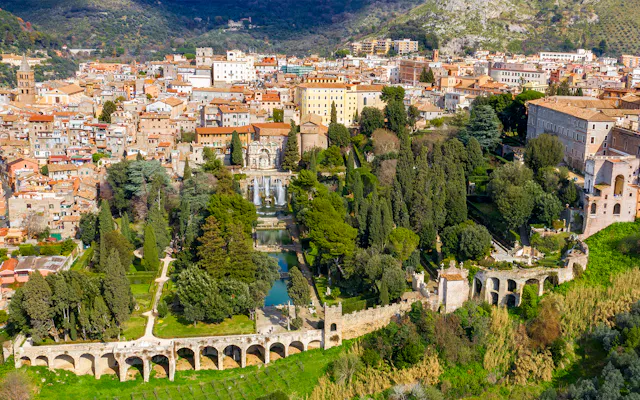
Four terraced hectares, roughly fifty fountains and not a single pump: everything has moved by gravity since 1560. Here's the right itinerary, fountain by fountain.
Free entry on the first Sunday of the month (Domenica al Museo) — official Ministry of Culture data
Real-time availability · free cancellation on many options
When Cardinal Ippolito II d'Este — son of Lucrezia Borgia, a runner-up for the papacy — turned a former Benedictine convent into his residence, he asked Pirro Ligorio for the impossible: to bring a river inside a garden. An underground channel roughly 600 metres long diverted part of the Aniene River beneath Tivoli; ever since, gravity alone feeds every jet, cascade and spray. Villa d'Este's Italian-garden model was copied everywhere from Versailles to Peterhof, and in 2001 UNESCO inscribed it as a World Heritage Site.
The garden is a checkerboard of terraces on a steep slope: the classic mistake is zig-zagging down and ending up climbing back twice. A tried-and-tested route:
The first hydraulic organ of the modern era: a chamber of air compressed by water pushes the pipes, and a toothed cylinder selects the notes. Restored and working again since 2003, it performs late-16th-century pieces. Arrive 10 minutes early and stand at the lower balustrade: the crowd gathers behind you.
A mechanical theatre from 1569: twenty bronze birds sing on air and water until an owl turns and silences them. It runs every two hours from 10:00am. Kids love it: use it as a "reward" halfway through the route.
Actually almost 300 spouts across three overlapping channels, representing the rivers Albuneo, Ercolaneo and Aniene carrying water from Tivoli to Rome. The moss covering them is deliberate: it's trimmed, not removed.
Jets up to 12 metres high make the garden's most photographed sight. The exact spot: the far end of the Fish Ponds, in the late afternoon, when the sun comes in at an angle and lights up the spray.
Ligorio summed up Rome in a single terrace: a miniature Tiber, the she-wolf, the seven hills. It's the cardinal's political statement: from Tivoli, he ruled over Rome, at least symbolically.
The garden ticket is the same as the villa's: you'll find prices and options in the ticket guide, and water-show times in the hours page.
No: the ticket (full price €15) includes both the palace and the gardens. You can't buy a "gardens only" entry.
About 51 monumental fountains, with hundreds of jets, cascades and basins linked by over 800 metres of channels. Everything runs on gravity using water from the Aniene River, with no electric pumps.
The Water Organ (Fontana dell'Organo) plays every two hours from 10:30am; the Owl Fountain (Fontana della Civetta) sings every two hours from 10:00am. Times are also posted at the entrance and can vary for maintenance.
Gardens only: 1.5–2 hours at an unhurried pace. With the frescoed palace: 2–3 hours. Add time if you want to wait for the Water Organ's performance (recommended).
No, picnicking isn't allowed in the historic gardens. There's a café inside the complex and dozens of bars and trattorias a short walk from the exit, in central Tivoli.
Partly: an accessible route with ramps and a lift covers the palace and main terraces, but the historic staircases remain the only access to some fountains. The up-to-date accessibility map is on the official site villae.cultura.gov.it.
In August and on weekends, the best time slots sell out fast. Lock in your date now — most options can be cancelled free of charge.
Check availability and prices